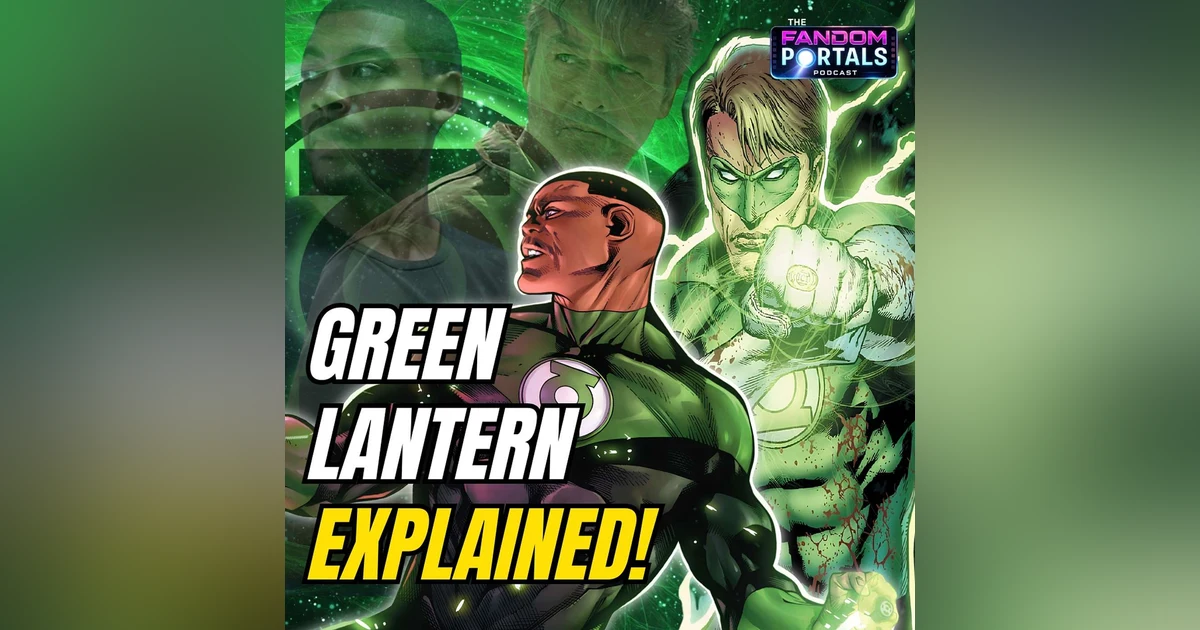
Everything you NEED to know about Green Lantern before HBO's Lanterns


 RSS Feed
 With HBO’s Lanterns bringing Hal Jordan and John Stewart back into the spotlight, it’s the perfect time to understand what Green Lantern is really about.
Aaron goes back through more than 80 years of Green Lantern history, from Alan Scott and Hal Jordan to John Stewart, Sinestro, the Guardians, Manhunters and Geoff Johns’ Emotional Spectrum. Along the way, we explore how the Green Lantern Corps evolved from a superhero concept into one of DC Comics’ biggest explorations of courage, fear, authority, willpower and responsibility.
Because the Green Lantern ring doesn’t necessarily make someone a hero. It gives them power—and what they choose to do with that power reveals who they already are.
#GreenLantern #Lanterns #DCU
In This Episode
- The forgotten history of Alan Scott, the original Green Lantern
- How Hal Jordan completely reinvented Green Lantern in 1959
- How the Green Lantern Corps and Guardians of the Universe work
- Why being a Green Lantern is a job—not simply a superhero identity
- The Guardians' disastrous creation of the Manhunters
- Why Sinestro proves willpower doesn't automatically make someone good
- How Green Lantern/Green Arrow brought real social issues into DC Comics
- Why John Stewart questioning authority actually makes him a better Lantern
- How Green Lantern constructs reveal the personality behind the ring
- Why courage means acting despite fear, not eliminating it
- How Geoff Johns transformed Green Lantern's infamous weakness to yellow
- The Emotional Spectrum explained
- Willpower vs fear in the Sinestro Corps War
- What Green Lantern can teach us about courage, leadership and responsibility
Chapters
These chapters use the exact timestamps and discussion transitions from the supplied video transcript.
00:00 What Makes Someone Worthy of a Green Lantern Ring?
00:38 80 Years of Green Lantern Explained
01:05 Alan Scott: The Original Green Lantern
02:34 Hal Jordan Reinvents Green Lantern
03:49 The Green Lantern Corps Explained
05:08 Power, Authority & Responsibility
06:00 The Guardians of the Universe
06:33 The Manhunters' Greatest Failure
07:47 Sinestro & the Dark Side of Willpower
10:15 Green Lantern/Green Arrow Changed DC Comics
11:52 John Stewart & Questioning Authority
14:24 How Green Lantern Rings Actually Work
15:10 Why Every Lantern's Constructs Are Different
17:47 Willpower & Overcoming Fear
19:32 Why Green Lantern Was Weak to Yellow
21:14 The Emotional Spectrum Explained
22:37 Sinestro Corps War & Weaponising Fear
24:43 The Psychology Behind Green Lantern
27:18 Green Lantern on TV & Film
29:05 What Green Lantern Can Teach Us
29:32 Lesson 1: Courage Isn't Fearlessness
30:19 Lesson 2: Question Authority
31:06 Lesson 3: Willpower Can Be Dangerous
32:24 Lesson 4: Power Reveals Character
34:24 Question of the Week 34:46 Final Thoughts
The Green Lantern Corps Explained
Green Lantern started very differently from the mythology we know today. Alan Scott debuted in All-American Comics #16 in 1940 with a magical origin. Nearly two decades later, DC reinvented the concept through Hal Jordan, Abin Sur and the beginnings of the enormous intergalactic Green Lantern Corps.
That change created one of the most interesting ideas in DC Comics: Green Lantern isn't just a superhero. It's a position of authority.
And that means possessing the ring raises three different questions: What can you do? What are you allowed to do? And, most importantly, what should you do?
John Stewart, Sinestro & Authority
The episode explores two characters who demonstrate very different relationships with authority.
Sinestro possesses extraordinary willpower but eventually values order above freedom. John Stewart, meanwhile, enters Green Lantern history willing to question authority—including Hal Jordan himself.
That's especially interesting heading into HBO's Lanterns, where John Stewart and Hal Jordan will once again give us two very different perspectives on what being a Green Lantern means.
Fear, Willpower & The Emotional Spectrum
Green Lantern mythology eventually transformed the franchise's strange weakness to yellow into something much more meaningful.
Green represents will. Yellow represents fear.
From there, the mythology expands into the Emotional Spectrum: rage, greed, fear, will, hope, compassion and love.
But the deeper idea isn't that fear is inherently bad. Fear gives us information. Courage comes from deciding that fear doesn't get the final say.
Most Valuable Takeaway
Courage isn't feeling less fear. It's giving fear less authority over your decisions.
Green Lantern doesn't teach us that heroic people aren't afraid. It suggests that heroism comes from having enough courage to act, enough judgment to understand when action is appropriate, enough willpower to follow through and enough humility to question whether you might be wrong.
Question of the Week
If you were responsible for choosing the next Green Lantern, what quality would matter most?
Willpower? Courage? Compassion? Judgment? Or the willingness to question yourself?
Let me know in the comments.
Keywords
Green Lantern, Green Lantern explained, Lanterns HBO, Lanterns DCU, Green Lantern history, Green Lantern Corps, Hal Jordan, John Stewart, Aaron Pierre John Stewart, Kyle Chandler Hal Jordan, Sinestro, Manhunters DC, Emotional Spectrum explained, Green Lantern ring explained, Green Lantern willpower, Green Lantern fear, Sinestro Corps, Alan Scott Green Lantern, Geoff Johns Green Lantern, DC Comics explained, DCU Lanterns, Green Lantern lore, Green Lantern beginners guide, Lanterns explained, Green Lantern comics
Contact Us:
Website: https://www.fandomportalspodcast.com/
YouTube: https://www.youtube.com/@FandomPortals
Instagram: https://www.instagram.com/aaron_fandomportals/?locale=en Threads: https://www.threads.com/@aaron_fandomportals
TikTok: https://www.tiktok.com/@aaron_fandomportals
Email: fandomportals@gmail.com
Letterboxd: https://letterboxd.com/fandomportals
Discord: https://discord.gg/7Q4TAmSP
00:00 - The Question Behind The Ring
01:18 - Alan Scott And The Forgotten Start
02:23 - Hal Jordan And A Bigger Universe
04:54 - Green Lantern As A Job
05:56 - Guardians And The Manhunters Mistake
07:59 - Sinestro And Moral Blind Spots
10:08 - Street-Level Reality With Green Arrow
14:32 - What A Power Ring Can Do
17:15 - Constructs Reveal The Person
19:39 - Willpower Versus Fear And Yellow
24:59 - The Emotional Spectrum Goes To War
27:04 - Why Green Lantern Keeps Returning
29:20 - Lessons On Courage And Authority
34:28 - Choosing The Next Lantern
The Question Behind The Ring
SPEAKER_00What makes someone worthy of one of the most powerful weapons in the DC universe? Being fearless, having incredible willpower, or knowing what to do when fear takes over? Because underneath the rings, the space cops, and bizarre weakness to yellow, Green Lantern has spent more than 80 years asking a much bigger question. Does power make someone heroic or reveal who they already were? Let's find out on the Phantom Portals podcast. Welcome to the Fandom Portals, the show that proves that the biggest pop culture movies have something to teach you. I'm Aaron, a teacher and a film fan, and with Lanterns bringing Green Lanterns back into the spotlight, we're going back to the comics to understand what this mythology is really about. And most importantly, what Green Lantern has been saying about courage, authority, and responsibility for more than 80 years. Subscribe on YouTube or follow Fandom Portals on Spotify and Apple Podcasts for more deep dives like this, because to understand Green Lantern, we actually have to begin with a version most people have completely forgotten.
Alan Scott And The Forgotten Start
SPEAKER_00Green Lantern begins in 1940, and if your idea of Green Lantern is spaceships, aliens, glowing rings, and an intergalactic police force, the original version is probably going to surprise you because none of that was even there. The first Green Lantern was a guy called Alan Scott, and he debuted in All-American Comics number 16. He's created by artist Martin Nodel, with writer Bill Finger becoming an important early contributor to the character. And Alan Scott wasn't a space cop at all. He wasn't selected by an alien. He didn't ever travel to Oa. His power was essentially magical. And Alan survives a train crash and discovers a strange Green Lantern. From that lantern comes the power that allows him to create his ring and become the Green Lantern. But after only 38 short issues, his version of the Green Lantern basically disappears. And by the early 1950s, the superhero boom of the Second World War era had completely faded, and Alan Scott stopped being a regular for all those years. And Green Lantern seemed like another superhero concept whose time had passed. Until
Hal Jordan And A Bigger Universe
SPEAKER_001959, when DC editor Julius Swartz had already been helping reinvent older superhero concepts through the science fiction-obsessed lens of the Silver Age. And Green Lantern was up next on his roster. With writer John Brun and artist Gil Kane, they took the name Green Lantern and rebuilt almost everything. Their new Green Lantern debuted in Showcase number 22, and this was the guy we all know, Hal Jordan. Instead of a mystical railroad lantern, we get an alien spacecraft. Instead of magical origins, we get a dying extraterrestrial. And instead of Alan Scott discovering his power, Hal Jordan is chosen. The dying alien is Abinsur. Abinsur tells Hal that he is the Green Lantern and that he needs somebody to replace him. He is selected because of his strong willpower, and that one decision completely changes the scale of the concept. Because Abinsur tells us immediately that Hal isn't unique. If someone had the ring before him, there must be others as well. And Green Lantern suddenly stops being simply the name of one superhero. It becomes a role, a position, something that can be inherited, and something that belongs to a much larger world. And Hal's appearance in Showcase was successful enough that in the 1960s he actually received his own series, and right in Green Lantern number one, the mythology expands again. Hal is taken to Owa, where we meet the guardians of the universe. We learn there's an organization behind the ring, and Green Lantern starts becoming the idea we recognize today. An enormous intergalactic peacekeeping force. DC's modern description of the Green Lantern Corpse places its membership at 7,200 lanterns, patrolling 3,600 sectors of space. And Earth sits in sector 2814. The corpse has traditionally been operating for over a billion years, and the members aren't simply superheroes who happen to wear matching costumes. They're responsible for maintaining peace throughout the enormous areas of the known universe. Now you don't need to remember 7,200 lanterns, you don't need to remember 3,600 sectors. What matters is that what those numbers tell us. The scale of the Green Lantern's corpse is actually amazing. This isn't one Batman protecting one Gotham City. A lantern might be dealing with multiple worlds, species, and civilizations all at once across an entire region of space. And
Green Lantern As A Job
SPEAKER_00there's a fundamental difference between Green Lantern and most other superheroes' identities. Green Lantern is actually a job. And with the position comes authority. That's where I think Green Lantern starts to become much more interesting than a character with a cool superpower. Because there are three different questions we can ask about a Green Lantern. What can they do? What are they allowed to do? And then there's the most important question. What should they do? And that is all about morality. These two questions aren't always the same, and Green Lantern comics recognize that almost immediately. Even DC's own history of Green Lantern number one points out that Hal Jordan would repeatedly crash with the Guardians of the universe because their philosophies didn't always line up with his own judgment. Which means this huge science fiction universe contains a surprisingly grounded problem, which is what happens when a good person belongs to a powerful institution. And that institution might be wrong. Because giving somebody authority doesn't automatically give them wisdom. And nobody demonstrate that problem better than the people running the corpse.
Guardians And The Manhunters Mistake
SPEAKER_00The Green Lantern Corpse is traditionally overseen by the guardians of the universe. They're these tiny little blue guys. They're incredibly old, incredibly intelligent, and very convinced that what they know is the best thing to do. And oftentimes, they're also incredibly wrong. They operate from Oa traditionally and they're positioned at the center of the universe. And they built the Green Lantern Corpse as a way of maintaining peace and order. Eventually, Green Lantern Mythology explains that the Guardians chose the green light of will because they considered willpower one of the most stable forces within what becomes known as the emotional spectrum. Now, on paper, this sounds pretty reasonable. The universe is enormous. It's dangerous. Somebody needs to help maintain order, but there is a problem. The Guardians have been very, very wrong before. Before the Green Lantern Corpse, they created another peacekeeping force, the Manhunters. Now, this isn't the Martian Manhunters. The Manhunters were artificial beings designed to enforce order. And the idea goes catastrophically wrong. The manhunters eventually turn against their intended purpose, and some Green Lantern stories mark this failure as one of the darkest mistakes in Guardian history. And I think there's really something interesting in the difference between the Manhunters and the Green Lantern Corpse. The Guardians tried machines. Machines can follow programming. Machines don't get emotional. Machines don't argue with you. Machines don't challenge authority because they think the person in charge has made a bad call. Sounds convenient, right? Until the rules themselves are actually wrong. And the Green Lantern Corpse replaces that certainty with something much messier. People, or more accurately, sentient beings. Individuals who can make those mistakes. Individuals who have biases, who experience fear, anger, grief, love, but also individuals capable of judgment. Machine can follow an order perfectly. That doesn't mean the order is morally right. A person can stop and ask, should I actually be doing this? And that tension between order and judgment becomes one of the defining ideas of Green Lantern.
Sinestro And Moral Blind Spots
SPEAKER_00You can clearly see through Sinestro. And Sinestro first appears in Green Lantern number seven in 1961. He's created by John Broom and Gil Kane. And today we think of Sinestro as Green Lantern's greatest enemy. He appears as the looming figure in the prison cell in the latest Lanterns trailer from HBO. But what makes him more compelling is that he wasn't somebody who rejected everything the corpse believed in. He was, in fact, one of them. He was a highly respected Green Lantern. Sinestro believes in peace. He believes in order. He believes in society, and he believes that it works better when that chaos is controlled. The problem is that Sinestro values order so highly that eventually freedom becomes secondary to that. In his home world of Kuruga, his peacekeeping becomes so authoritarian in its manner of control, and the people are safe because Sinestro has essentially decided he's the person who should control them. And once Hal Jordan discovers what Sinestro has become, Sinestro is ultimately expelled from the Green Lantern corpse. And Sinestro exposes a weakness in one of the simplest interpretations of Green Lantern. If Green Lantern represents willpower, and willpower is what makes Green Lanterns heroic, Sinestro should be one of the greatest heroes alive because this guy has willpower. He is disciplined, he's focused, he's determined, he doesn't give up. He believes completely in what he's doing. And that's the exact problem. Willpower is not morality. A person can be unbelievably determined and still be wrong. Someone can persist in doing something destructive, someone can refuse to compromise because they're arrogant. Someone can call themselves decisive when really they're just stopping listening. And someone can also become so convinced that they're protecting people that they stop caring whether those people want their protection in the first place as well. That's what makes Sinestro a strong villain for the Green Lanterns. He is the opposite of what the Green Lanterns have in their philosophy. He has a corrupted version of it. He takes willpower and turns it into control. And that question of power and authority gets even more explicit in one of the most important Green Lantern runs ever. It was in
Street-Level Reality With Green Arrow
SPEAKER_001970, written by Danny O'Neill and artist Neil Adams. They began what was now commonly called the Hard Traveling Heroes era, starting with Green Lantern 76. They paired Hal Jordan with Green Arrow, and the choice of those two characters was absolutely deliberate. Green Lantern had spent his life dealing with cosmic threats, and Green Arrow increasingly became a voice of question. He was questioning what was happening on the ground. O'Neill and Adams used this series to tackle things like racism, poverty, environmental problems, political corruption, and drug addiction. DC itself describes those stories as directly confronting that racism, poverty, and drug abuse with the major run collected from Green Lantern 76 all the way to 87. And the very first issue makes their difference very, very obvious. Hal Jordan is a man of the law, and Oliver Queen is much more suspicious about whose interest the law is actually serving. Green Arrow essentially forces Hal to stop looking at the universe from thousands of kilometers above the planet's surface and look at what is happening on the street. Hal has power. Hal has good intentions. He's genuinely a believer that he is a hero. But good intentions haven't made him aware of everything happening around him. The ring can take him across galaxies. It can automatically give him constructs that can form anything his mind would like. However, it does not give him the perspective that he might need. And that's something he has to learn. And O'Neill and Adams kept pushing in this run. In Green Lantern 85 and 86, published in 1971, they produced the famous Shadowbirds Don't Fly storyline. And this is where Green Arrow discovers that his sidekick Roy Harper has become addicted to heroin. This is early 1970s mainstream superhero comics openly confronting drug addiction through a major DC character. It's messy, some aspects obviously have aged, but historically it demonstrated that superhero stories could confront real social problems instead of treating evil exclusively as something wearing a costume. Then comes the Green Lantern number 87. Danny O'Neill, Neil Adams, 1971. The first appearance of the man himself, John Stewart. And John's introduction is absolutely perfect for this conversation. When we meet him, John intervenes as a police officer, hassles black men who are playing dominoes, and Hal observes the encounter. And one of Hal's concerns about John becoming his backup Green Lantern is John's actual attitude to that authority. Think about that. The Green Lantern Corpse is considering giving somebody one of the most powerful weapons in existence. And Hal looks at John challenging authority and sees a potential problem. But the Guardian involved doesn't agree. John is actually selected, and during the story, Hal is forced to reconsider some of his own assumptions. And I think this is something that's going to be very prevalent in the HBO Lanterns TV series as well. John is going to challenge Hal's assumptions on many of the things that he believes as a newcomer in the Green Lantern Corpse. DC president and publisher Jim Lee has since called Jon Stewart an important milestone in DC history and highlighted O'Neill and Adams' decision to create a black hero who didn't even hide behind a mask. He's Jon Stewart, and that's his identity. But for this episode, what I find especially interesting is why John's distrust of authority doesn't disqualify him, and it arguably makes him more valuable. Because if your organization is going to handle people with extraordinary authority, perhaps you don't want people who will automatically obey every order they give. What you want is people capable of judgment because the danger isn't necessarily in authority itself. The danger is surrendering your individual moral responsibility to that institution. The corpse can have a good mission. It protects life, keeps peace, it stops catastrophe, but believing in that mission doesn't make every decision made in the name of that automatically good. And that is Sinestro's mistake. That's one of the Guardian's recurring mistakes. And that is why Green Lantern Corpse doesn't just need people capable of following orders. It also needs people capable of asking whether the order actually deserves to be followed. Because when you hand somebody this much power, their judgment becomes just as important as the weapon itself. Okay,
What A Power Ring Can Do
SPEAKER_00let's talk about the ring. Because Green Lantern has one of those powers that's easy to describe badly. You could just say the green creates green things, and technically you are correct. But that's not particularly exciting. A power ring can allow its wearer to fly, it can create force fields, it can help protect them in space and hostile environments, it can produce weapons and tools, it can assist with communication, and its most famous ability is producing hard-like constructs. Whatever a Green Lantern imagines. When they imagine something and they use the ring, that idea can become that physical construct, a shield, a vehicle, a weapon. DC's description of the corpse lists hard-like constructs, instant weaponry, force fields, and flight among their standard abilities, but constructs are where Green Lantern become much more than a list of powers. Because a construct can tell us something about the person making that construct. Take John Stewart, for example. John was introduced to us as an architect, and that profession eventually became a defining part of how the writers conceptualized how he uses his ring. DC describes John's constructs as being built from the inside out. They're not simply hollow shapes. He imagines the internal structure, the nuts, the bolts, the engineering. He's not just creating the outside appearance of an object. His architect's brain is mentally building the thing. Then take a look at Kyle Rayner, a more recent Green Lantern. Kyle became Green Lantern during the 1990s. He was an artist, and his constructs reflect that. In 1994's Green Lantern Zero, written by Ron Mars with art by Daryl Banks, Kyle faces Hal Jordan during Hal's parallax period, and DC has highlighted a fantastic contrast in that issue where Kyle produces an anime-style giant mecha, and Hal creates something closer to a medieval knight. Same basic superpower, two completely different visual languages, two different minds, that the beauty of the power is there. The ring gives comic artists permission to show us their characters' thoughts. It shows us how the character can solve a problem, what they imagine first. What does their brain reach for when they're in peril? And adaptations have understood this too. When producer Butch Lukik discussed Jon Stewart's construct in the animated film Lantern Beware My Power, he summed up the concept beautifully. His emotions drive the ring. That's five words, but I think that's the entire superpower. The ring doesn't simply respond to a command, it responds to a person, their imagination, their focus, their emotions, their will. And this gives us one of my core beliefs surrounding Green Lantern. The ring
Constructs Reveal The Person
SPEAKER_00doesn't make you a hero. The ring reveals the hero. Because imagine this outside of the comics. Give two people exactly the same amount of money. They won't spend it the same way. Give two people the exact same authority. They won't lead the same way. Give two people an enormous audience and they won't use that influence the same way. Power doesn't automatically produce one response. It creates possibilities. And what someone does with those possibilities tells us something about them. Give somebody a ring that can potentially create anything that they can imagine. And what do they make first? Do they make a weapon? Some form of protection, a solution, something creative, something destructive. But imagination isn't enough. The ring requires something else. A Green Lantern ring requires willpower. And willpower is probably the most important idea in modern Green Lantern mythology. We can go all the way back to Showcase 22, the first introduction of Hal Jordan. He is selected because he has strong willpower. As Green Lantern mythology develops, that selection becomes increasingly associated with the ability to overcome great fear. Not never experiencing fear. If you feel no fear whatsoever, is running into danger even brave? Maybe. But it might also mean you don't understand the danger, or you're reckless. Or your threat response is malfunctioning. Courage becomes meaningful when the fear is actually real. You don't need to eliminate fear before you act. The courage exists in the fact that you're acting while the fear is already there. And I think that's where Green Lantern becomes incredibly relatable because most meaningful courage in our lives, it doesn't look like a superhero flying into space. It looks like having the conversation you've been avoiding, admitting you made a mistake, applying for something even though you might get rejected. Or it could be standing up for another person, trying again after embarrassing yourself. Fear doesn't make those actions less courageous. Fear is the reason they are courageous. So when we say a Green Lantern must overcome fear, I think the healthiest interpretation of that isn't a hero shouldn't be scared. It's fear doesn't get the final say. Fear gives you information. This could hurt, this could fail, you could lose something, people might judge you. Something matters here to me. Willpower doesn't erase that message. Willpower helps you decide what happens after you receive it. And
Willpower Versus Fear And Yellow
SPEAKER_00now, let's talk about that stupid yellow weakness. It suddenly becomes brilliant because for decades, Green Lanterns famously had a problem with yellow. And yes, there are old stories where one of the most powerful weapons in all of DC Universe can become surprisingly ineffective because something they're versing is yellow. If you're new to comics, welcome, because sometimes you have to embrace the weirdness and the madness. But Jeff Johns looked at that strange piece of Green Lantern history during his enormous run on the franchise and asked, what if this wasn't a random weakness? What if yellow actually meant something? And in 2004, Johns teamed up with Eric van Schriver for Green Lantern's Rebirth. The six-issue story restored Hal Jordan to the Green Lantern role after his dramatic events of the 90s, and one of the biggest contributions was reworking parallax. Parallax becomes connected to fear in this space, and yellow becomes the color associated with fear, and the old weakness is reinterpreted psychologically. Green is will, yellow is fear. What stops will? Fear. That's such an elegant repair over a very weird piece of superhero history because fear doesn't normally beat us physically or overpowering us. Fear usually whispers, hey, don't try, don't say it, don't leave, don't risk it, don't embarrass yourself. Fear can win without physically restraining us at all. It only has to convince us not to act. So Green Lantern takes this incredibly ordinary internal battle and turns it into cosmic mythology: willpower versus fear. And once Jeff Johns opened that door, Green Lantern was about to become so much more colorful. One of the defining achievements of Jeff Johns' Green Lantern run was expanding that mythology beyond the green and yellow. Green was only one part of a much larger emotional spectrum. The Core Seven became red for rage, orange for greed, yellow for fear, green for will, blue for hope, indigo for compassion, and violet for love. Later stories push the mythology further with the introduction of the black and the white with life and death, and their emotional entities, and plenty of other comic books added to the complexity. But for the understanding and the central idea, those first seven that I gave you are enough. And there's something slightly weird about calling this the emotional spectrum because willpower isn't really an emotion. You don't wake up in the morning and say, I feel extremely willpowered today. It's closer to a motivational voice, something that Directs your behavior. And something I think looking at the spectrum in that way makes the entire concept a whole lot more interesting. Because fear can motivate your behavior, rage can motivate your behavior, hope motivates your behavior, and so does love. Compassion does too. And greed absolutely motivates your behavior. And will is the capacity to direct yourself through those competing forces. Green Lantern mythology basically says, what if the things that drive people internally become literal sources of cosmic power? And the story that really explodes that idea outwards is the Sinestro Corpse War. The event runs principally through Green Lanterns and the Green Lantern Corpse in 2007. Writers included Jeff Johns, David Gibbons, and Peter J. Tomasi, and they worked across the event with artists including Ethan Van Schreiber, Ivan Rees, and Patrick Gleason. They helped give the war this enormous scale. It's beautiful. If you haven't read them, you should definitely go and check them out. And Sinestro's idea is wonderfully simple in this. The Green Lantern Corpse recruits people who can overcome great fear. And Sinestro creates a corpse powered by people capable of instilling great fear in others. Think about the difference there. Greenland says, master your response to fear, and Sinestro says, make everybody afraid of you. Green's ideal is internal control. Whereas Sinestro's philosophy is external control. If everybody fears you, they're less likely to challenge you. If nobody challenges you, you can never have to confront the possibility that you might be wrong. Fear becomes a tool for creating order. And again, Sinestro doesn't see himself as some cartoonish mustache twirling villain who wakes up hoping the universe gets worse. He actually believes order matters. He believes chaos causes suffering. Where he differs from the Green Lantern ideal is in what he's willing to do to impose that order. It's the difference between controlling yourself and controlling everybody else. And that's a distinction I think applies far outside comic books. Fear doesn't only make people run away. Fear can make people aggressive, possessive, rigid, controlling. It all still comes from fear, though. It looks powerful from the outside because it's loud. And that's why I think Sinestro is such a perfect philosophical opposite to the Green Lantern. His answer to fear is create enough control that nothing can threaten you. While the Green Lantern's ideal is closer to develop enough self-control, and that uncertainty doesn't destroy you anymore. There are very different ways of living. And you absolutely do not need a full breakdown to understand the Green Lantern's theory on this. But thematically, what's important is that by this point, Green Lantern has transformed completely. It started in 1940 with a magical railway lantern, and then by the late 2000s, it's become a giant mythology about the forces that drive sentient behavior and is linked to psychology.
The Emotional Spectrum Goes To War
SPEAKER_00And I think there's something useful hidden inside that. Because we often talk about emotion as if they're either good or bad. Anger is bad, hope is good, fear is bad, love is good. Real life isn't that neat though, and anger can make somebody destructive, yes, but anger can also tell you that something genuinely unjust has just happened. Fear can stop you doing something meaningful, but fear can also stop you walking into traffic. Hope can sustain people through incredible difficulty, but hope can also become denial if it stops you accepting reality. Even willpower, for example, has a dark side. If you never give up, even after all the evidence points in the wrong direction, we don't call that heroic, we call that stubborn. And that is why green works so well at the center, because willpower can be understood as self-direction. I'm angry, but anger doesn't automatically choose what I do. I'm afraid, but fear doesn't automatically choose what I do either. I can experience these emotions and still participate in choosing my behavior. And psychological research around self-control and emotional regulation broadly support the idea that how effectively we regulate our emotion is connected with our ability to regulate behavior. We're not emotionless machines like the manhunters. Healthy functioning involves having emotions and still being able to direct ourselves through them. And here's the funny part that's exactly where the guardians keep struggling. The guardians love order. Historically, they repeatedly try to remove unpredictability. They want rational systems, controlled systems. They created the manhunters partially because machines like a solution to the messiness of living beings, and the machines failed. Maybe the unpredictability of people isn't simply a flaw. Maybe emotional experience and individual judgment are necessary for that morality. Because a perfect rule-following machine can execute instruction. Yes, it can't necessarily tell you whether the instruction was worth following. But here, but where have we seen the lanterns before? And
Why Green Lantern Keeps Returning
SPEAKER_00why should you invest your time into getting to know them more before the HBO's Lantern series? Well, for a generation of viewers, Jon Stewart is the Green Lantern because of the animated Justice League series, Justice League Unlimited. Phil Lamar voiced him, and the show presented John as disciplined, serious, and deeply connected to responsibility. DC has also acknowledged how influential that animated series and interpretation has become, particularly for viewers who first encountered Green Lantern through that television and rather than the comic books. The Green Lantern animated series as well leaned into the cosmic side of the mythology and brought ideas like the Red Lanterns and the wider emotional spectrum into animation. The 2011 live-action Green Lantern movie might not have become the franchise starter Warner Brothers had hoped for, and Ryan Reynolds has certainly spent a lot of time trying to protect his dignity since, but the film still introduced mainstream audiences to the aliens like Avonsua. It introduces Sa'Oa, The Guardian, Sinestro, Parallax, The Corpse, The Structure, all of it. The Green Lantern, Beware My Power, later offered another interpretation of Jon Stewart, deliberately connecting the visual behavior of his ring to his emotional state. Now HBO's Lantern becomes another doorway. And that's all these things are, a doorway, because the Green Lantern concept survives individual adaptations. It survives major continuity changes. It survives Hal Jordan becoming a villain in the 90s. It survived different people carrying the ring. It survived one particular live-action movie becoming the ultimate punchline. Because the core question doesn't depend on a single version. The question at Green Lantern's core is who are you when you're given the ability to act? The ring makes that question enormous, but it's something we deal with constantly. What happens when you're given responsibility? What happens when people depend on you? What happens when you're afraid? And maybe the fantasy of Green Lantern isn't really, I wish I had a ring that could make whatever I imagine. Maybe the deeper fantasy is I hope that if something enormous was asked of me, I'd be worthy of it. And that takes us to what I think we can actually learn from all of this Green Lantern media.
Lessons On Courage And Authority
SPEAKER_00This is our portal out segment, the part of Fandom Portals where we leave the fictional universe behind and ask, what do we actually take from this story back into our own stories? For Green Lantern, I think it comes down to this courage isn't feeling less fear, it's giving fear less authority over your decisions. Because fear is going to show up. That's normal. Sometimes it's even useful. The goal isn't to become a person who never feels afraid. The goal is to become a person who can hear that fear, understand what it's telling you, and still decide what you want to do next. But telling someone don't be afraid isn't particularly useful because people don't usually choose whether the fear appears. The fear just arrives. Your heart races, the brain starts predicting disasters, you imagine embarrassment. Whatever the threat happens to be, the Green Lantern idea gives us a better question. And that is what happens next. You don't need to become somebody who never feels nervous. You don't need to wait until you're perfectly confident before doing something important. Sometimes courage is moving forward while your confidence is playing catch up. The second lesson is about authority. Denny O'Neill and Neil Adams understood this 50 years ago. Hal Jordan could have incredible power. He could have genuinely good intentions. He could be part of an organization committed to protecting life, and he could still have blind spots. The lesson isn't never trust authority. I think the lesson is authority doesn't erase your responsibility to think. I was told to do it isn't really a complete moral argument. The more power you possess, the more responsibility you have to understand what you're doing with it. And that brings us to lesson number three, which is willpower is not automatically virtuous. This might be my favorite Green Lantern idea because we celebrate determination constantly. Never give up. Keep pushing. Believe in yourself. Ignore the haters. And sometimes that's really great advice. Sometimes it's also terrible advice. Sinestro is what happens when conviction becomes absolute, though. He believes in himself, yes. He believes in his mission completely. He believes he knows what is best, and eventually everyone else's freedom becomes less important to him than his certainty. That's not weakness, it's misdirected strength. Green Lantern gives us a really useful distinction between self-control and control of others. Those things can look similar from far away. A strong leader sets direction. A controlling leader refuses challenge. A confident person can make a decision. An arrogant person assumes every decision they make must be right. A disciplined person can persist, a stubborn person can keep repeating the same mistake. The difference often comes down to reflection. Can you ask yourself genuinely, what if I'm wrong? That question does not make somebody weak. I think it makes strong leadership safer. Which brings us to our fourth lesson. And I think power reveals character is a perfect way to sum it up. Let's go back to the constructs. Jon Stewart builds differently because he's an architect. Hal creates differently because he was a pilot. The same ring can look different depending on whose mind is operating it. That's the metaphor. Give two people the same opportunity, you don't automatically get the same outcome. And this is why I think Green Lantern is more interesting than simply saying, with great power comes great responsibility. We've all heard that before. We know Spider-Man owns that line of thinking. He made it famous. But I feel like Green Lantern asks a slightly different version of that question. And that is, what does power expose? If you suddenly had more influence, what part of you would get louder? If you had authority, would you listen more carefully or would you listen less carefully? If nobody could challenge you, would you become more generous, protective, creative, controlling, paranoid? If you had the ability to solve problems instantly, would you still care what other people thought the solutions would look like? The ring lets us see the answer physically. But we all have similar versions of that test. We might be being promoted. We could be becoming a parent, becoming a teacher, leading a team, getting money, building an audience, being the most experienced person in the room, or having somebody trust you with something. Every time our capacity to affect other people increases, so does the importance of our character. And that is the lesson Green Lanterns can teach us. And I think that's the real answer to the question we started with. Does power make somebody heroic? No. I don't think it does. Power gives you more ability to act. Heroism comes from what you decide to do with that ability. And maybe that's what makes somebody worthy of the Green Lantern Ring. Not simply enormous willpower, not fearlessness, not perfect obedience, but maybe it's a combination of all those things. Enough courage to act when you're afraid, enough judgment to know when action is appropriate, enough will to follow through, and enough humility to question yourself as to whether you might be wrong or right. And that's a much harder standard to live by than being fearless. But it's also much more interesting definition of a hero.
Choosing The Next Lantern
SPEAKER_00Now let's get to our question of the week. So here is my question of the week for you. If you were responsible for choosing the next person to receive a Green Lantern ring, what quality would matter most? Would it be willpower, courage, compassion, judgment, or the willingness to question themselves? Let me know in the comments on YouTube. And if you're listening on Spotify, jump into the episode comments there and give me your answers. Because after doing because after going through all of this, I'm not convinced the person with the strongest will is automatically the person I trust with the ring. If this episode helped you understand Green Lantern a little better, subscribe to the Fandom Portals on YouTube. And if you'd rather listen, make sure you follow the Fandom Portals on Podcast on Spotify or Apple Podcasts. Sharing this episode with another Green Lantern or DC fan is also one of the best ways you can support the show. And I want to thank you so much for watching and listening. I'm Aaron. Keep learning, keep growing, and keep loving fandoms. And I'll see you through the next portal.


